 +7 (988) 379-41-22






Books, Articles, Resources on Balancing
TYPES OF ROTOR BALANCING
Balancing is a procedure aimed at equalizing the masses of a rotating rotor. During operation, their uneven distribution leads to vibrations, which cause increased loads on bearings, foundations, and other unit components. The consequence of this impact is a reduction in equipment service life. To prevent wear, it is necessary to know how a rotor is balanced.
STATIC BALANCING
The following methods of this type of balancing exist:
Selection of a correction mass. Static rotor balancing is used at low angular speeds along the axis of rotation. The procedure is performed in a specific sequence. First, the rotor is placed on a horizontal plane. Under the action of the moment of gravity, it begins to roll until it assumes a stable position. In this case, the heavy part of the rotor ends up at the bottom. For balancing, the part is rotated 90° so that this point is in the horizontal plane. A counterbalancing mass is installed on the opposite side.
Circular traversal. The rotor circumference is conventionally divided into 8 equal parts, which are marked. The part is placed in balancing equipment so that the first point is in the horizontal plane. A mass is installed at this location, turning the rotor by 45°. This moves the second point into the horizontal plane. The weight used is removed and weighed. A new mass is selected for the second point, causing the rotor to turn another 45° to the next mark. The procedure is repeated for all points.
DYNAMIC BALANCING
This type of balancing aims to eliminate static and moment unbalance. It is performed using the following methods:
Weight traversal. During this dynamic balancing of rotors, the vibration amplitude of the unsecured bearing is measured. A trial weight is attached to the divisions on the end side of the part. Then, the resonant vibrations caused by the balancing mass are measured. The results are displayed on a graph for calculations. If necessary, the position and mass of the weight on the rotor end are changed. If the part is balanced in one plane of the first support, its second end is secured, and the procedure is repeated using correction and additional weights.
Maximum marks. The cylindrical part of the rotor, or journal, is coated with chalk. One support of the part is fixed while the second is freely balanced in the vertical plane. The rotor is rotated. During resonant revolutions at maximum amplitude, marks are made on the chalked surface. The midpoint of their location is the point of rotor runout. This mark is transferred to the end part of the component. On the same surface, offset by 90°, a second point is marked, where a trial weight is installed. During rotor rotation, new marks are made in the same places. Coincidence indicates correct weight placement but insufficient mass. Therefore, this parameter is increased until separate marks disappear. The second support undergoes a similar procedure.
TYPES OF BALANCING MACHINES BY THE NUMBER OF ROTOR DEGREES OF FREEDOM
A balancing machine is high-precision equipment equipped with an electronic measuring system used to determine the magnitude and location of static or dynamic unbalance in rotors symmetrical about the axis of rotation. These units are produced as:
With a fixed rotor axis. This type of balancing machine features one degree of freedom of the rotating part. Unbalance in this case is determined by measuring support vibrations. Their distribution is determined by the placement of the center of mass relative to the bearings or planes. When working with heavy rotors, their axial drive and a fixed base, such as the floor or unit foundation, are used. The machine's soft suspension causes bearing vibration. Therefore, a calibration rotor is used to calibrate the unit. When rotating lightweight parts, vibration helps maintain the force ratio. In this case, the mass of the plate mounted on the suspension springs exceeds the weight of the rotor.
With a fixed rotor axis. This type of balancing machine provides two degrees of freedom for the rotor. The units are characterized by a rigid connection between the oscillating frame and the base in the direction perpendicular to the axis. This equipment operates in resonant mode. Significant angular oscillations of the frame allow for precise measurements. This requires the use of a drive that provides a constant rotational speed. Balancing procedures performed on this equipment are based on measuring unbalance in two planes, alternately aligned with the fixed axis. When working with heavy and medium rotors, the machines are installed on an isolated foundation; with light ones, on plates with a soft suspension.
With a fixed plane of rotor axis oscillation. Machines in this group have three degrees of freedom for the rotating part. During their operation, unbalance is determined by the oscillations of the supports in two correction planes in one start. Measurement accuracy depends little on external vibrations. This is explained by the ability to adjust the natural frequency of oscillation of the rotating part. When working with small electric motor rotors, the influence of vertical interference can be significant. To eliminate them, vibration isolation is performed using suspension with rubber pads or an isolated foundation. The machines operate in a sub-resonant mode.
With spatial oscillation of the rotor axis. Such machines have seven degrees of freedom for the part. During rotation, the rotor axis moves together with the oscillating frame. The vibrations of only static or moment unbalance are determined by the movements of its arbitrary point. The possibility of arbitrary movement of points allows for the design of specialized machines for a specific type of balancing. The units provide rigidity in all axes of rotation. Why are balancing machines of this type needed? They are used to determine unbalance when working with flexible rotors. Due to the absence of a rigid connection with the foundation, the system allows setting parameters that reduce the unit's sensitivity to external vibrations. There is a function to select the direction for measuring oscillations.
METHODS AND MEANS OF BALANCING
BALANCING METHODS
Balancing methods are classified according to a number of features:
- by purpose — balancing of parts, rigid, quasi-flexible and flexible assembled rotors, rotors in-situ
- by rotor speed during balancing — without part rotation, low-speed and high-speed balancing
- by number of correction planes — single, two, and multi-plane balancing
- by measured parameter during balancing — with measurement of amplitude, phase, amplitude and phase of displacement, vibration velocity, vibration acceleration, force in supports, stresses in the rotor
- by number of measured parameters during balancing — one, two, more than two parameters
- by method of mass correction — by adding, removing, or moving correction masses
- by method of finding the relationship between unbalances in correction planes and measured parameters — experimental (trial run method), computational, experimental-computational.
The main methods for balancing rigid assembled rotors are methods of low-speed dynamic balancing in one or two correction planes. The relationships between unbalances in the correction planes and the measured parameters are established by the trial run method or by preliminary calculation.
Methods for low-speed balancing of quasi-flexible rotors differ from methods for low-speed balancing of rigid rotors in that the unbalances in the correction planes are established according to a specific law. For rotors with known unbalance distribution, methods of balancing by the main vector and main moment are used. This uses two or three correction planes. Rotors with unknown unbalance distribution are balanced in many correction planes, distributing the correction masses along the length of the rotor proportionally, to the displacement of the rotor axis relative to the main central axis of inertia, or according to another law.
Methods for balancing flexible rotors require high rotational speed, many correction planes, and measurement of rotor displacements in several sections and support vibrations. The relationships between unbalances in the correction planes are found by experimental and experimental-computational methods.
To achieve 1st and 2nd accuracy classes for balancing rigid and quasi-flexible rotors, the method of high-speed in-situ rotor balancing is used. Typically, balancing is performed in one or two correction planes using the trial run method based on measurements of housing or support stand vibration amplitudes. High-speed balancing of flexible rotors in-situ is performed by experimental-computational methods.
The perfection of a balancing method is determined by the achievable residual unbalance value in the correction plane, the unbalance reduction coefficient per one mass correction, and the balancing duration.
The choice of balancing method depends on the technical requirements for balancing, organizational and economic conditions of the given production. The balancing method is chosen at the stage of rotor design, development testing, and technological preparation of production.
MEANS OF BALANCING
Balancing means are divided into:
- technological equipment (including inspection and testing equipment)
- technological tooling (including tools and inspection means)
- means of mechanization and automation of production processes
Technological equipment for implementing the balancing process includes: balancing and metal-cutting machines and other equipment.
A balancing machine is a machine used to determine and reduce rotor unbalances; they are classified according to the following features:
- by purpose — for static and dynamic balancing
- by operating mode — sub-resonant, super-resonant, and resonant
- by type of drive for rotating the balanced rotor — with drive shaft, drive belt, product's own drive
- by equipment with mass correction means — equipped with mass correction means, measuring
- by level of automation — with manual control, semi-automatic, automatic, and automatic machine lines
- by passport sensitivity threshold — normal and high precision.
On a machine for static balancing, the main vector of rotor unbalances can be determined:
- using gravity on a non-rotating rotor
- on a rotating rotor (in dynamic mode)
On machines for dynamic balancing, the unbalanced rotor rotates at a constant frequency in special supports.
Depending on the operating mode, rotation occurs around the main central axis of inertia of the rotor (super-resonant machine) or the rotor axis (sub-resonant machine).
On sub-resonant machines, dynamic forces in the supports are measured and, according to the laws of statics, the unbalances in the correction planes of the unbalanced rotor are found.
On super-resonant machines, support vibrations are measured and the relationship between support vibrations and unbalances in the rotor correction planes is established experimentally.
High-speed machines for dynamic balancing, called spin balancing stands, are equipped with non-contact sensors for measuring displacements of the rotating rotor in several sections.
Machines for dynamic balancing have unbalance indicators: measuring instruments, analog or digital computers that allow obtaining information about rotor unbalances. A set of measuring instruments with vibration sensors, which allows obtaining information about rotor unbalances during in-situ balancing in its own bearings and supports without installation on a balancing machine, is called a balancing kit.
Metal-cutting machines are used during balancing for mass correction by removing material from rotor surfaces. For this, lathe group machines, as well as drilling, milling, and grinding machines are used.
Mass correction of the rotor is also carried out using other machines and units, for example, welding units, lasers, electrochemical machines, etc.
TECHNOLOGICAL TOOLING
This includes:
- fixtures for balancing and metal-cutting machines
- inspection means
- fit-assembly tools, cutting tools, and auxiliary materials
Fixtures for metal-cutting machines are designed to connect the workpiece (rotor) during mass correction with the machine and cutting tool. For these purposes, universal or special machine fixtures are used. The most common are machine vices, chucks, jigs, faceplates, etc.
Performing preparatory, working, and final operations of the balancing process is accompanied by technical control of linear, angular dimensions, and mass. For these purposes, measuring tools and instruments are used, ensuring the specified measurement accuracy, high reliability, and low labor intensity.
During balancing, both simple measuring tools (metal rulers, feeler gauges, technical levels) and more complex ones — vernier tools, micrometers, lever-mechanical instruments (dial indicators) — are used.
Depending on the machine design, the balanced rotor, and the method of mass correction, general fitter or special assembly tools, cutters, milling cutters, drills, and other cutting tools are used.
During technical maintenance of machines, preparation of rotors for balancing, lubricating oils, wiping materials, anti-corrosion agents, and other auxiliary materials are used.
Means of mechanization and automation. Along with automatic and semi-automatic machines, automatic lines, small-scale mechanization and automation means are relevant.
Mechanization is aimed at partially or completely replacing human manual labor with a machine while retaining human participation in its control. Automation of the process is aimed at transferring the control functions previously performed by humans to machines and instruments.
Selected chapters from the book by Levit M.E., Ryzhenkov V.M. "Balancing of Parts and Assemblies". Moscow, "Mashinostroenie" publishing house, 1986.
Rotor unbalance is a vector quantity equal to the product of the part's weight by the distance from its axis to the center of mass. This phenomenon occurs during the production or restoration of products, as well as during the assembly of units. Its quantitative value changes. Unbalance must be eliminated to prevent premature wear of not only parts but the entire unit as a whole. The balancing procedure is performed by installing counterweights or removing metal on heavy sections of the rotor. Correction is carried out at the maximum radius. This is due to the fact that as the distance from the axis increases, the influence of the weight on the part's equilibrium increases. After balancing is completed, the shift of the center of mass remains. It is called residual unbalance and is assessed by several methods.
ASSESSMENT AT LOW ROTATIONAL SPEED
To assess residual unbalance, a method based on its comparison with the limit values provided in GOST 22061 is used. Low-speed balancing machines are used as equipment for the procedure. This type of unbalance assessment is performed after installing all rotor elements: gears, half-couplings, etc. During the procedure, the part is rotated at balancing speed to measure the angles and values of unbalances in all planes.
ASSESSMENT AT SEVERAL ROTATIONAL SPEEDS
This type of unbalance assessment is performed to account for its distribution. Data on rotor flexibility are used for the procedure. To assess balance, calculations are made based on equivalent residual modal unbalances for all modes. The procedure takes place in several stages. First, the rotor is installed in a balancing unit and rotated. A speed close to the corresponding critical indicator of bending vibrations is set. Then, the vibration values occurring on the bearing supports are read. Trial masses are installed on the rotor so that the unbalance they cause is sufficient to influence the part's vibrations. After readings are taken, the masses are removed. Next, a speed close to the second corresponding critical indicator of bending vibrations is set. The process is repeated for all modes.
ASSESSMENT AT OPERATING SPEED
The residual type of rotor unbalance can be assessed by two given correction planes. When using the operating rotational speed, their optimal position is selected. Tests are carried out on balancing equipment where the rotor is installed on support bearings. During unbalance assessment at operating speed, sensors measuring support, shaft, or bearing vibration have no resonances capable of influencing the readings. If the equipment drive creates additional unbalance, this value is compensated.
A dynamically unbalanced rotor during balancing is considered as a fully balanced rotor, in whose correction planes point unbalanced masses are attached. When such a rotor rotates at a constant angular speed around a fixed axis, variable loads arise on the rotor supports and its axis bends. The loads on the rotor supports are proportional to the unbalances in all correction planes


The coefficient of proportionality is called the balancing sensitivity, or sensitivity to unbalance, and is denoted by two indices: the first index corresponds to the name of the support, and the second to the number of the correction plane. Balancing sensitivity depends on the rotational speed of the rotor during balancing, the distance from the correction plane to the support, mass, stiffness, damping, and other parameters of the rotor and supports. In the general case, a is a vector quantity that determines the ratio of the change in support vibrations to the change in the measured unbalance value. Balancing sensitivity is found by calculation or experimentally.
For a rigid rotor, it is sufficient to measure the loads or vibrations of the supports at a constant rotational frequency to determine the main vector and main moment of unbalances or two unbalance vectors. These vectors are generally different in value and non-parallel, lie in two arbitrary planes perpendicular to the rotor axis, and completely determine its dynamic unbalance. Mass correction is also sufficient to be carried out in two planes.
The unbalances of a flexible rotor, which determine the unbalance according to the n-th bending form, are determined at rotational speeds close to the corresponding n-th natural frequency of bending vibrations of the rotor-support system, i.e., at rotational speeds at which deformations of the elastic line characteristic of the n-th bending form occur. Mass correction is carried out in many planes perpendicular to the rotor axis, for each bending form.
Elastically deformable rotors are balanced at low rotational speeds as rigid rotors. However, the correction masses are placed in many planes according to a certain law.
The process of dynamic balancing consists of the following stages:
- At a constant rotational speed, the loads or vibrations of the supports of the dynamically unbalanced rotor are measured.
- Based on the results of support vibration measurements, the balancing sensitivities and unbalances in the measurement planes are found by calculation or experimentally. Usually, the measurement planes coincide with the planes of the rotor supports.
- The unbalances in the given correction planes, the values and angles of the correction masses are calculated.
- Mass correction of the rotor is carried out according to the requirements of the technical documentation.
- Depending on the specified balancing accuracy, rotor class, equipment used, and many other factors, various methods of dynamic balancing are used.
Selected chapters from the book by Levit M.E., Ryzhenkov V.M. "Balancing of Parts and Assemblies". Moscow, "Mashinostroenie" publishing house, 1986.
Balancing engineering uses terms from various fields of science, technology, and production. Unified terminology contributes to the correct understanding of the tasks solved during balancing and reduces errors in work. The definitions of terms given below can be changed in form if necessary, but the meaning of the concept should not be violated.
MECHANICS
Mechanical motion — change in the position of a body relative to other bodies. Mechanical motion is determined by trajectory, distance traveled, speed, and acceleration.
Scalar quantity — a quantity, each value of which can be expressed by one number.
Vector quantity — a quantity that, in addition to numerical value, has direction.
Inertia — the phenomenon of maintaining the speed of motion of a body or state of rest in the absence of the action of any other forces.
Mass — a measure of the inertia and gravitational properties of a body.
Force — a vector quantity serving as a measure of mechanical interaction between bodies. In nature and technology, forces of gravity, elasticity, friction, and other forces act.
Moment of force — a mechanical quantity equal to the product of the force and the distance from the point of force application to a given point (pole) or axis.
Oscillations — a process of alternating increase and decrease, usually in time, of some quantity.
Mechanical oscillations — oscillations of the value of a kinematic or dynamic quantity. Mechanical oscillations are determined by time, amplitude, phase, angular frequency. Mechanical oscillations can be free, forced, resonant, etc.
Vibration — motion of a point or body, during which oscillations of the scalar quantities characterizing it occur. Vibration is characterized by vibration displacement, vibration velocity, vibration acceleration, vibration overload.
Rotational motion around an axis — motion in which all points, moving in parallel planes of the body, describe circles with centers lying on one straight line, perpendicular to the plane of these circles and called the axis of rotation. Rotation is determined by the angle of rotation, angular velocity, angular acceleration.
Moment of inertia of a body relative to an axis — a quantity that is a measure of the body's inertia in rotational motion around this axis.
Rotor — a body that, during rotation, is held by its supporting surfaces in supports. In balancing engineering, rotors are divided into classes: rigid, elastically deformable, flexible, and others.
Supporting surface of the rotor — journal surfaces or surfaces replacing them. The supporting surface of the rotor transmits loads to the supports through plain or rolling bearings.
UNBALANCE AND IMBALANCE
Unbalance — the state of a rotor characterized by such a distribution of masses that during rotation causes variable loads on the rotor supports and its bending. Unbalance of a rigid rotor can be static, moment, dynamic, quasi-static. Unbalance of a flexible rotor can be according to the n-th bending form.
Mass eccentricity — the radius vector of the center of the considered mass relative to the rotor axis.
Point unbalanced mass — a conditional point mass with a given eccentricity, causing variable loads on the supports and bending of the rotor during rotation.
Unbalance — a vector quantity equal to the product of the unbalanced mass and its eccentricity. Unbalance is completely determined by value and angle.
Correction mass — a mass used to reduce rotor unbalances.
Correction plane, reduction plane, measurement plane — a plane perpendicular to the rotor axis, in which the center of correction masses is located, unbalance is specified, unbalance is measured.
Initial and residual unbalance — unbalance in the considered plane perpendicular to the rotor axis, before and after mass correction.
Permissible unbalance — the largest residual unbalance in the considered plane of a rigid rotor or unbalance according to the n-th bending form of a flexible rotor, which is considered acceptable.
Technological unbalance — the difference between the values of residual unbalances in the same planes of the rotor, measured for the assembled product and for the rotor assembly unit.
Operational unbalance — the difference between the values of residual unbalances in the same planes of the rotor, measured on the assembled product before the start of its operation and after it has exhausted the entire assigned technical resource or resource until repair involving balancing.
BALANCING
Balancing — the process of determining the values and angles of rotor unbalances and reducing them by mass correction.
Low-speed balancing — balancing at such a rotational speed at which the balanced rotor can still be considered rigid.
High-speed balancing — balancing at such a rotational speed at which the balanced rotor can no longer be considered rigid.
In-situ balancing — balancing of a rotor in its own bearings and supports without installation on a balancing machine.
Static balancing — balancing during which the main vector of rotor unbalances, characterizing its static unbalance, is determined and reduced.
Moment balancing — balancing during which the main moment of rotor unbalances, characterizing its moment unbalance, is determined and reduced.
Dynamic balancing — balancing during which the rotor unbalances, characterizing its dynamic unbalance, are determined and reduced.
Balancing according to the n-th bending form — balancing of flexible rotors in a given range of rotational speeds to reduce variable loads on the rotor supports and its bending caused by unbalance according to the n-th bending form.
BALANCING MEANS
Balancing machine — a machine that determines rotor unbalances to reduce them by mass correction.
Machine for static balancing — a balancing machine that determines the main vector of unbalances using gravity on a non-rotating rotor or on a rotated rotor.
Machine for dynamic balancing — a balancing machine that determines unbalances on a rotor rotated by it.
Spin balancing stand — a balancing machine that determines the loads on the rotor supports and the bending of its axis on a flexible rotor rotated by it during high-speed balancing.
Balancing kit — measuring instruments that allow obtaining information about rotor unbalances during its in-situ balancing.
Balancing mandrel — a balanced shaft on which the product to be balanced is mounted.
Balancing frame — a fixture for a balancing machine on which the product to be balanced is installed.
Reference rotor — a rotor used to check a balancing machine.
Calibration rotor — one of the serial rotors used for calibrating a balancing machine.
Setting up a balancing machine — a process including mechanical adjustment of the rotor drive, installation of fixtures, separation of correction planes, calibration of the measuring device.
Threshold of sensitivity of the balancing machine by value and angle of unbalance — the smallest change in the value and angle of unbalance that the balancing machine can detect and indicate under given conditions.
One of the features of the technological classification of balancing machines is the degree of their universality, i.e., the variety of rotors for which they can be used. The greater this diversity, the wider the technological capabilities of the machine. Balancing machines are divided into four types: universal, for specific purposes, special, and balancing kits.
Universal balancing machines are used in serial production to determine unbalances of rotors of various designs. This type includes super-resonant and sub-resonant machines with axial or belt drive, possessing high accuracy and quick changeover to a new type of rotor. They can balance rotors differing in mass, length, and diameter by 10..40 times. Universal balancing machines are characterized by permissible rotor mass and diameter, distance between machine supports, range of rotor rotational speeds, drive power, and machine accuracy.
Minimum permissible rotor mass — the mass of the balanced rotor at which the specified machine accuracy is ensured. The maximum permissible mass is limited by the strength of the support suspension. It includes the mass of the rotor, its bearings and housing, tooling, i.e., the entire mass installed on the machine supports.
Permissible rotor diameter depends on the distance from the support centers to the machine bed (floor). The maximum distance between machine supports is limited by the length of the bed guides, and the minimum by the thickness of the stands.
For machines whose supports have a socket for bearing installation, its diameter or the largest diameter of the rotor journals is indicated.
The range of rotor rotational speeds during balancing corresponds to the frequency range of the measuring device, the rotational speed and power of the drive device.
Universal balancing machines are manufactured in normal and high precision.
For balancing rotors weighing from several grams to tens of kilograms, super-resonant machines with belt drive connection are used. The measuring devices of these machines usually have a selective amplifier, stroboscope, and potentiometric chain for separating correction planes. The machine is set up for a given rotor type using a calibration rotor.
Balancing of rotors weighing up to 1000 kg is performed on super-resonant and sub-resonant machines with both axial and belt drives with various measuring devices.
Universal balancing machines for rotors weighing more than 1000 kg are manufactured with axial drive and wattmetric measuring device. Supports of machines for heavy rotors are made sub-resonant.
Machines for specific purposes are designed for balancing car wheels, fans, electric motors in their own housing, etc., or for specific types of balancing — static, high-speed. These machines are less universal, have a smaller range of characteristics, but are designed for higher productivity. They are manufactured on the basis of universal machines and equipped with additional devices (for example, correcting devices and special tooling). A special place among type 2 machines is occupied by vertical balancing machines and machines for high-speed balancing of flexible rotors.
Vertical balancing machines are designed for static balancing in dynamic mode of parts that do not have their own supporting surfaces. The operating principle and design of the main machine units are similar to horizontal machines. A distinctive feature of vertical machines is the presence of a spindle with a vertical axis of rotation, at the end of which there is a clamping device. These machines are characterized by permissible mass and diameter of the balanced part, range of rotational speeds, drive power, and machine accuracy.
A two-spindle drilling head moves along the vertical guides of the machine, with the help of which mass correction of the part is performed by drilling out the required amount of metal. The machine can operate in semi-automatic mode.
Machines for high-speed balancing of flexible rotors have sub-resonant supports, axial drive with a wide range of rotational speeds, measuring device with eddy current sensors. At high speeds, rotors weighing up to 300 tons are balanced.
Therefore, to reduce power losses due to air friction, the balancing device with the rotor is placed in a sealed chamber, in which a vacuum of up to 100 Pa is created using a vacuum pump. Machines for high-speed balancing are complex devices with additional systems ensuring rotor transportation, lubrication of its supports, vacuum in the chamber, etc.
Special balancing machines are used in large-scale and mass production for balancing rotors of a certain mass and geometry. A special machine is manufactured in several copies. To increase balancing productivity, special machines are equipped with means of mechanization and automation. The degree of machine automation depends on production conditions and can vary.
In the simplest case, it includes only the determination of unbalances; in more complex cases — mass correction and rotor transportation.
Balancing kits are designed to determine rotor unbalances during balancing in their own bearings and own housing without installation on a machine. As balancing kits, measuring devices of balancing machines, general-purpose vibration measuring instruments, and special balancing instruments are used.
Selected chapters from the book
Levit M.E., Ryzhenkov V.M. "Balancing of Parts and Assemblies". Moscow, "Mashinostroenie" publishing house, 1986.
This section describes the device, operating principle, and design of the main units of machines for dynamic balancing; typical units are considered according to the principle of the functions they perform; rules for assessing the accuracy standards of balancing machines, uniform for manufacturers and consumers of machines, are given.
 In the general case, a balancing machine contains: balancing, drive, measuring, and correcting devices, as well as additional devices that are attached to the machine bed.
A super-resonant balancing device (Fig. 1, a) consists of two movable supports or a platform and elastic elements suspending the supports on the machine bed. The stiffness of the elastic elements is different in different directions. In machines with a horizontal axis of rotation, the elastic elements are relatively rigid in the vertical direction, while in the horizontal direction the stiffness is very low and the suspension does not hinder oscillations. When designing and manufacturing super-resonant machines, the mass of the supports, length, suspension stiffness, and other parameters of the balancing device are selected so that its natural frequency in the horizontal direction is many times lower than the rotational frequency of the rotor during balancing.
 When an unbalanced rotor rotates in a super-resonant balancing device, the movable supports will oscillate in the horizontal plane. The amplitudes of these oscillations are proportional to the unbalances in the rotor correction planes, i.e., are described by equations (2).
A sub-resonant balancing device consists of two fixed supports rigidly fixed to the machine bed. The natural frequencies of support oscillations in all directions significantly exceed the rotational frequencies of the balanced rotors. The lower part of the support is a dynamometer or force bridge. Dynamic loads arising in the supports during rotation of an unbalanced rotor create small displacements on the dynamometer (Fig. 1, b), which are amplified by a lever system. The force in the support is proportional to the displacement, i.e.,
 , where k is the stiffness coefficient of the support in the horizontal direction.
In a sub-resonant balancing device according to the force bridge scheme (Fig. 1, c), a sensor is installed in one of the arms of the force bridge, measuring directly the dynamic load from the unbalanced rotor, described by equations (1).
The balancing devices of spin balancing stands and machines for high-speed balancing of flexible rotors have the same stiffness in all directions — are isotropic and have three or four supports.
The operating principle of balancing devices of machines with a vertical axis of rotation is similar to those described above. These devices are often structurally combined with the drive device. The balanced part is fixed in the spindle unit. The spindle, suspension, and sometimes the drive device constitute the balancing device of the machine with a vertical axis of rotation.
 The drive device ensures starting, maintaining constant angular velocity of rotation, and braking of the balanced rotor. The main elements of the device are: electric motor, gearbox, brake, drive connection, control circuit for the drive device.
Balancing machines use electric motors of alternating or direct current of various power, stepped and stepless transmissions. Belt drives are used for relatively small transmitted forces. These drives use flat, V-belts, and round belts. Gear drives provide transmission of high powers and stepped speed regulation. In machine gearboxes, cylindrical gears with different numbers of teeth are used, introduced sequentially into engagement with each other. Changing the gear ratio in the drive is sometimes done by changing gears.
The drive connection links the output shaft of the gearbox with the balanced rotor. Axial, belt, and tangential connections are distinguished. Axial connection is carried out using cardan shafts (Fig. 2) of various designs. In belt connection, flat endless belts are used, encircling the balanced part (Fig. 3).

Fig. 2. Axial connection by cardan shaft: Fig. 3. Belt connection by flat endless belt:
1 — drive; 2 — cardan shaft; 3 — balanced part 1 — belt; 2 — balanced part; 3 — drive
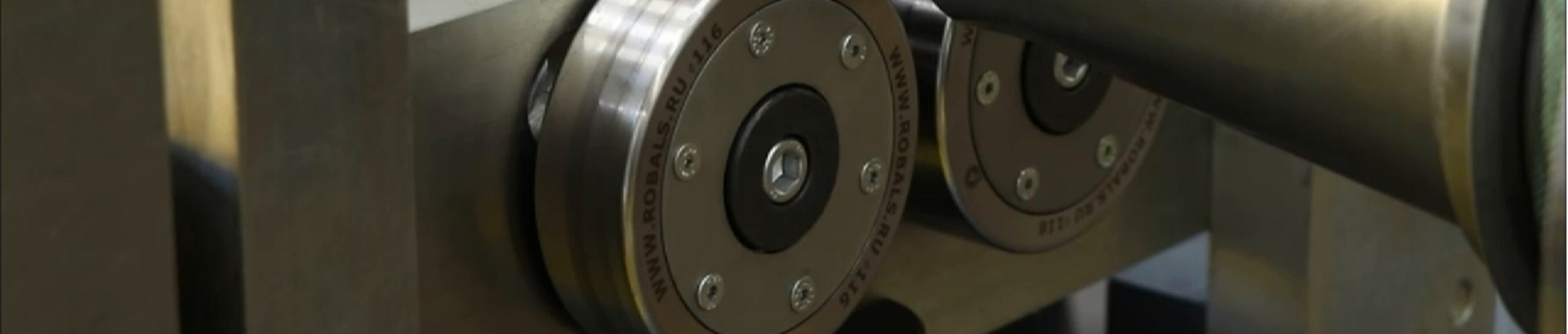
Tangential connection is created by pressure rollers (Fig. 4, a) and round belts (Fig. 4, b).

Fig. 4. Tangential connection:
1 — balanced part; 2 — pressure roller;
3 — round belt
 Drive connections are capable of transmitting limited torques. Therefore, to avoid destruction of the drive device during rotor starting and braking, a special electrical control circuit for the drive device is used, ensuring smooth starting and stopping of the rotor.
Thyristor systems are used to control three-phase asynchronous electric motors with squirrel-cage rotor and DC electric motors. The use of these systems in balancing machines allows: controlling the electric motor in a non-contact way, limiting shock moments during starting, obtaining a wide range of start-brake and adjustment modes of electric motor operation.

The measuring device determines the values and angles of rotor unbalances in given planes. Its structural diagram consists of sensors, a chain for separating correction or measurement planes, frequency-selective means, indicators of unbalance value and angle.
Sensors convert the parameters of the balancing device oscillations into electrical signals. Balancing machines use contact (inductive, piezoelectric) and non-contact (eddy current) sensors.
 An inductive sensor is an inductance coil (Fig. 5, a) that can freely move in a magnetic field formed by a permanent magnet. The coil is rigidly connected to the balancing device. When this device oscillates, the coil will also oscillate and an EMF of induction will arise in it, the magnitude of which is determined by the rate of change of the magnetic flux, i.e., proportional to the oscillation velocity of the balancing device. At constant rotor speed, the EMF is proportional to the displacement amplitude of the machine supports.
A piezoelectric sensor is based on the piezoelectric effect. During mechanical deformation in a certain direction, for example, of Rochelle salt crystals, polarized ceramics, and barium titanate, an electric field arises in them (Fig. 5, b), changing the signs of charges when the direction of deformation changes. The magnitude of the charge arising during the piezoelectric effect is proportional to the acting force.
Inductive and piezoelectric sensors are connected to the oscillatory system of the machine, i.e., they are contact sensors.
Eddy current sensors are non-contact, therefore they serve to measure deflections of rotating shafts. The operating principle of an eddy current sensor is based on induction currents (Foucault currents) arising in a massive conductor, which is the rotor, placed in a changing magnetic field. The changing magnetic field is created by a high-frequency generator (Fig. 6) and an oscillatory circuit consisting of inductance L and capacitance C. Changes in the gap between the sensor surface and the shaft during its rotation cause a change in the output voltage.

Fig. 5. Eddy current sensor
For marking the unbalance angle, rotor speed during balancing, reference signal generators, stroboscopes with gas-discharge lamps, photoelectric and some other sensors are used.
The rotor of the reference signal generator is a two-pole permanent magnet rotating at the speed of the balanced rotor and rigidly connected to it. The stator has two mutually perpendicular windings and can be turned to any fixed position together with the scale marked on the stator body. The output voltage of the generator is constant in magnitude with a known phase relative to the angle mark on the rotor and has the rotational frequency of the rotor.
When illuminating a rotating rotor with a neon, pulsed, or other gas-discharge lamp, a stroboscopic effect occurs. This effect occurs because the human eye does not distinguish light pulses with a frequency of more than 10 Hz as separate flashes but perceives them as a continuous light flow. If the pulses follow at the rotational frequency, the rotor will appear motionless to the human eye. This principle is the basis of the stroboscope, which illuminates during balancing a scale (mark) applied to the rotor. The illuminated number indicates the unbalance angle relative to a known position.
A photoelectric sensor is triggered by a contrasting mark applied to the rotor and outputs short pulses at the rotational frequency of the rotor.
The electrical circuit between the vibration measuring transducers and the frequency-selective means is called the correction plane separation circuit (CPSC). The CPSC automatically solves equations (1)-(5) with respect to rotor unbalances.
The sensors of a super-resonant balancing machine are connected in the CPSC in series (Fig. 6, a) with such polarity that their EMFs act opposite to each other. A setting potentiometer R1 or R2 is included in the circuit of the compensating sensor. The voltage at the output of the circuit E_out is the sum of the full voltage of the main sensor and part of the voltage of the compensating sensor. The correction plane separation circuit is supplemented with switches that reverse the phase of the sensor voltages and switches that commutate the setting potentiometers to one or the other sensor. Since the positions of the potentiometer sliders and switches are different for separating the 1st and 2nd correction planes, the setting controls in the circuit are duplicated.

Fig. 6. Connection diagrams of sensors in potentiometric correction plane separation circuits
In the measuring devices of balancing machines, other correction plane separation circuits are also used. During multi-plane balancing, analog or digital computers equipped with calculation programs are included in the measuring device instead of the correction plane separation circuit. The oscillations registered by vibration transducers are caused both by rotor unbalance and by dynamic balancing errors. The component of oscillations from errors is called interference oscillations, as opposed to useful oscillations from unbalances.
Correcting devices are part of balancing machines intended for large-scale and mass production. They correct the rotor mass after its stop or during rotation. When operating in automatic mode, correcting devices are controlled by the measuring device.
Balancing machines use various additional devices that ensure its functioning. These are pneumatic and hydraulic systems, loading and accumulating devices, etc.
Selected chapters from the book by Levit M.E., Ryzhenkov V.M. "Balancing of Parts and Assemblies". Moscow, "Mashinostroenie" publishing house, 1986.